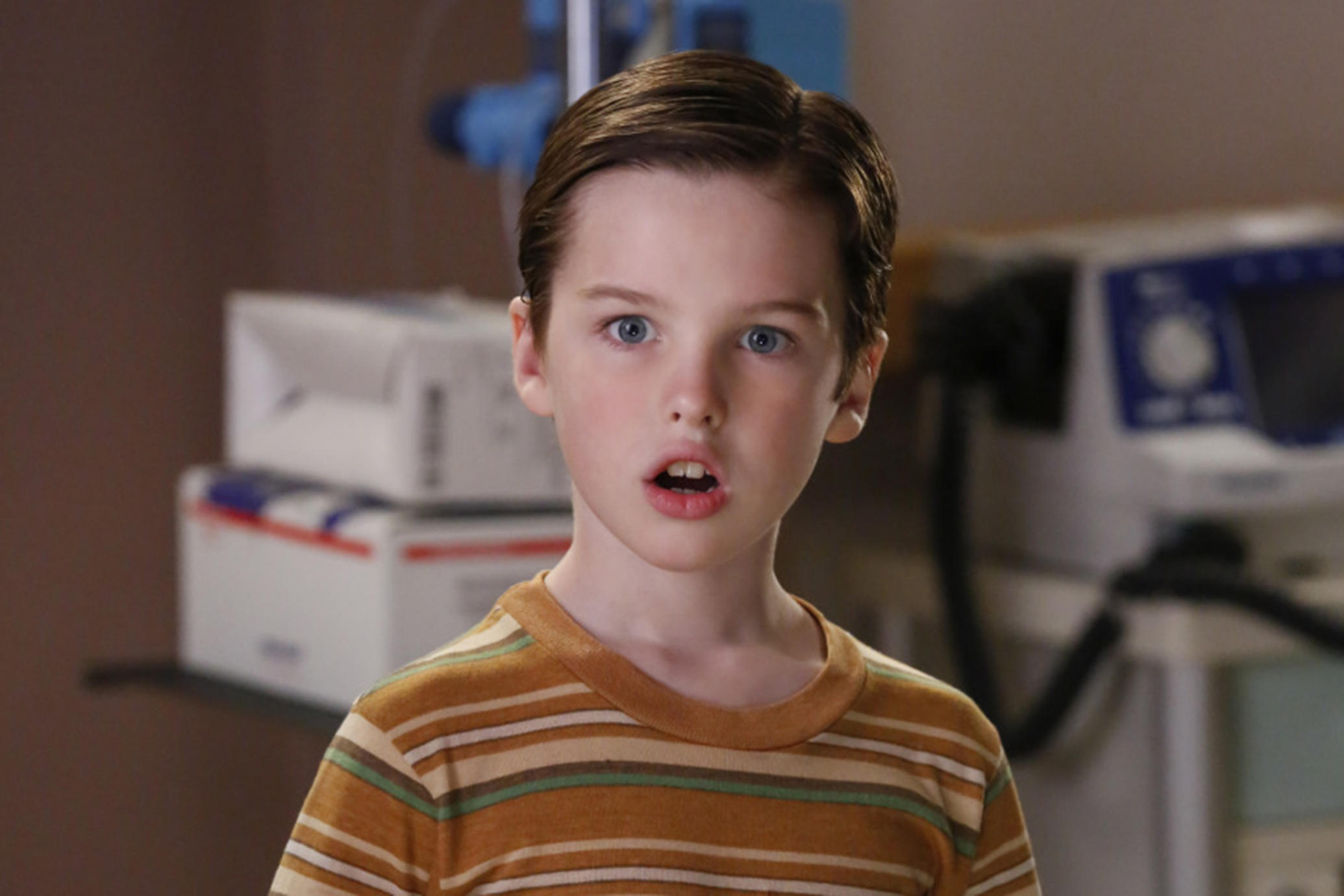
You know the one. It’s that grainy clip or still image of a pint-sized Sheldon Cooper—specifically the version played by Iain Armitage—staring intensely at a chunky, beige late-80s monitor. Usually, there’s some high-tempo, slightly distorted music playing in the background. Maybe he’s typing like his life depends on it. Maybe he’s just looking smugly at a screen while a caption above him describes a situation where someone is "locking in" or performing a ridiculously complex task for a very stupid reason.
The young sheldon computer meme isn't just another flash-in-the-pan TikTok trend. It’s actually a fascinating case study in how Gen Z and Gen Alpha take a broadcast television show—one that was originally marketed toward older "The Big Bang Theory" fans—and strip it for parts to create a whole new digital language. It’s weird. It’s loud. Honestly, it’s kinda brilliant how a show about a child prodigy in East Texas became the universal symbol for "I am currently overthinking this."
The Origin of the Sheldon Typing Visual
To understand why this blew up, we have to look at the source material. Young Sheldon, which premiered on CBS back in 2017, follows the early life of Sheldon Cooper. Because the show is set in the late 1980s and early 90s, the technology is delightfully retro. We’re talking Tandy computers, dot-matrix printers, and the glorious clack-clack-clack of mechanical keyboards.
The specific "computer" visuals that fuel the meme usually come from Sheldon’s early obsession with computing power. In the show, Sheldon uses his computer for everything from calculating the family’s taxes to trying to solve the Unified Field Theory. It’s that juxtaposition that makes the meme work. You see a 9-year-old in a bowtie using a machine that has less processing power than a modern toaster, but he’s doing it with the intensity of a hacker in a cyberpunk movie.
Memes thrive on "The Grind." In late 2023 and throughout 2024, the "Young Sheldon locking in" variant became the dominant version. "Locking in" is internet slang for entering a state of extreme focus. When you see that clip of Sheldon staring at the screen, the caption usually says something like, "Me at 3 AM researching why a random actor from a movie I saw 10 years ago looks familiar."
Why This Specific Show Conquered TikTok
It’s easy to dismiss this as just random humor. It’s not. There are a few very specific reasons why the young sheldon computer meme has more staying power than, say, a random clip from The Office.
First, there is the Iain Armitage factor. The kid is a great actor. He plays Sheldon with this rigid, unblinking intensity that translates perfectly to a five-second loop. If he looked like a normal kid just playing a game, it wouldn't be funny. Because he looks like he's trying to dismantle the federal reserve with a BASIC script, it becomes "meme-able."
Second, the show’s popularity on Netflix changed everything. For a long time, Young Sheldon was just "that show my grandma watches on CBS." But when it hit streaming platforms, a younger audience discovered it. They didn't necessarily watch it for the heartwarming family dynamics or the 80s nostalgia. They watched it because the character of Sheldon is inherently absurd. He’s a "Sigma" character before that term even existed—socially detached, hyper-fixated, and utterly convinced of his own superiority.
The Evolution of the "Locking In" Aesthetic
The meme started simple. It was just Sheldon at a computer. Then, the internet did what it does best: it added layers of irony.
People started pairing the footage with "Phonk" music. If you aren't familiar, Phonk is a subgenre of electronic music characterized by cowbells, distorted bass, and a high-energy, aggressive "dark" vibe. Putting aggressive Phonk over a scene of a small boy in a sweater vest learning how to use a mouse is peak internet humor. It creates a "hard" aesthetic for a character who is famously anything but.
Some creators took it even further. They started using AI to expand the frames or distort Sheldon’s face. There are "brain rot" versions of these memes where Sheldon is surrounded by flashing lights and Minecraft parkour footage. It's sensory overload. But at the heart of it is still that one image: the kid, the computer, and the focus.
Deep Lore: The Computer He’s Actually Using
If you’re a tech nerd, the meme is actually pretty cool because the show runners were surprisingly accurate with the hardware. In many of the scenes that became memes, Sheldon is using a Tandy 1000.
The Tandy 1000 was a big deal in the 80s. It was IBM-compatible but cheaper, sold through RadioShack. For a kid like Sheldon, it was the ultimate tool. Seeing that chunky monitor and the specific way the text crawls across the screen in the memes adds a layer of "vintage" credibility. It appeals to the part of our brains that loves old-school aesthetics, even if the person making the meme wasn't alive when RadioShack was a thing.
Misconceptions About the Meme’s Meaning
A lot of people think the meme is making fun of Young Sheldon. In some cases, sure, it’s ironic. But more often than not, it’s a form of "relatability" humor.
When you see a meme of Sheldon typing frantically with the caption "Me trying to find the song that goes 'doo doo da doo' on Google," the joke isn't that Sheldon is a nerd. The joke is that we are all Sheldon now. We all have that moment where we sit at a computer and become hyper-focused on something completely trivial. Sheldon is just the most visually perfect representation of that state of mind.
It’s also worth noting that the meme has helped the show’s ratings. Usually, when a show becomes a "meme," it signals the end of its serious lifespan. For Young Sheldon, it actually helped bridge the gap as the show transitioned into its final seasons and eventually its spin-off, Georgie & Mandy's First Marriage. It kept the character relevant in a landscape where traditional sitcoms usually die silent deaths.
How to Properly Use the Young Sheldon Computer Meme
If you’re looking to join in or just want to understand the "meta" of the joke, there’s a certain way these are constructed. You can't just slap any caption on it.
- The Hyper-Fixation: The caption must involve a task that requires way more effort than it's worth.
- The High Stakes: The music should imply that the world is about to end if the task isn't completed.
- The Speed: If it’s a video meme, the footage is often sped up slightly to make Sheldon’s typing look superhuman.
Common examples usually involve gaming (e.g., "Me researching the entire history of a boss I can't beat"), arguing on the internet ("Me pulling up the chat logs from 2021 to prove I was right"), or deep-diving into weird Wikipedia rabbit holes.
The Cultural Impact of "Sheldon-Core"
We’re seeing a weird shift in how we consume media. We don’t need the whole story anymore. We just need the "vibe." The young sheldon computer meme is the "vibe" of intellectual intensity divorced from any actual consequence.
It’s a bizarre legacy for a spin-off of The Big Bang Theory. While the original show was often criticized for its "nerd blackface" or making fun of geniuses, the Young Sheldon memes feel different. They feel like an embrace of that weird, obsessive energy. It’s okay to be the kid in the bowtie if you’re "locking in."
Future Proofing the Trend
Will it die? Probably. Most memes have a shelf life of about three months before they become "cringe." But the Sheldon typing visual has survived longer than most because it’s so versatile. As long as people are still overcomplicating simple tasks or staying up too late on the internet, there will be a place for a small boy and his Tandy 1000.
Interestingly, we’re seeing "counter-memes" now. People are using footage of Sheldon’s brother, Georgie, to represent "normal" behavior, contrasted against Sheldon’s computer-obsessed frenzy. This creates a whole ecosystem of memes based on a single show, proving that even in 2026, traditional TV still has a massive grip on digital culture.
Actionable Takeaways for Digital Creators
If you want to capitalize on this or similar trends, keep these points in mind:
- Look for high-intensity, low-stakes visuals. The reason Sheldon works is because he’s a kid doing something "serious." That contrast is the engine of the joke.
- Audio is 50% of the meme. The "Phonk" or "Brazil Funk" music transitions are what turned a boring TV clip into a high-energy edit. Never underestimate the power of a distorted bassline.
- Lean into the "Lock In" culture. The internet currently rewards productivity humor and hyper-fixation. If you can frame a character as being "on the grind," you’re halfway to a viral hit.
- Keep it short. The best versions of this meme are under 7 seconds. They loop perfectly, making you want to watch the "clack-clack" of the keyboard over and over again.
To stay ahead of the next wave, watch for other "intense" child characters in retro settings. The combination of nostalgia and modern "grindset" humor is a winning formula that isn't going away anytime soon.