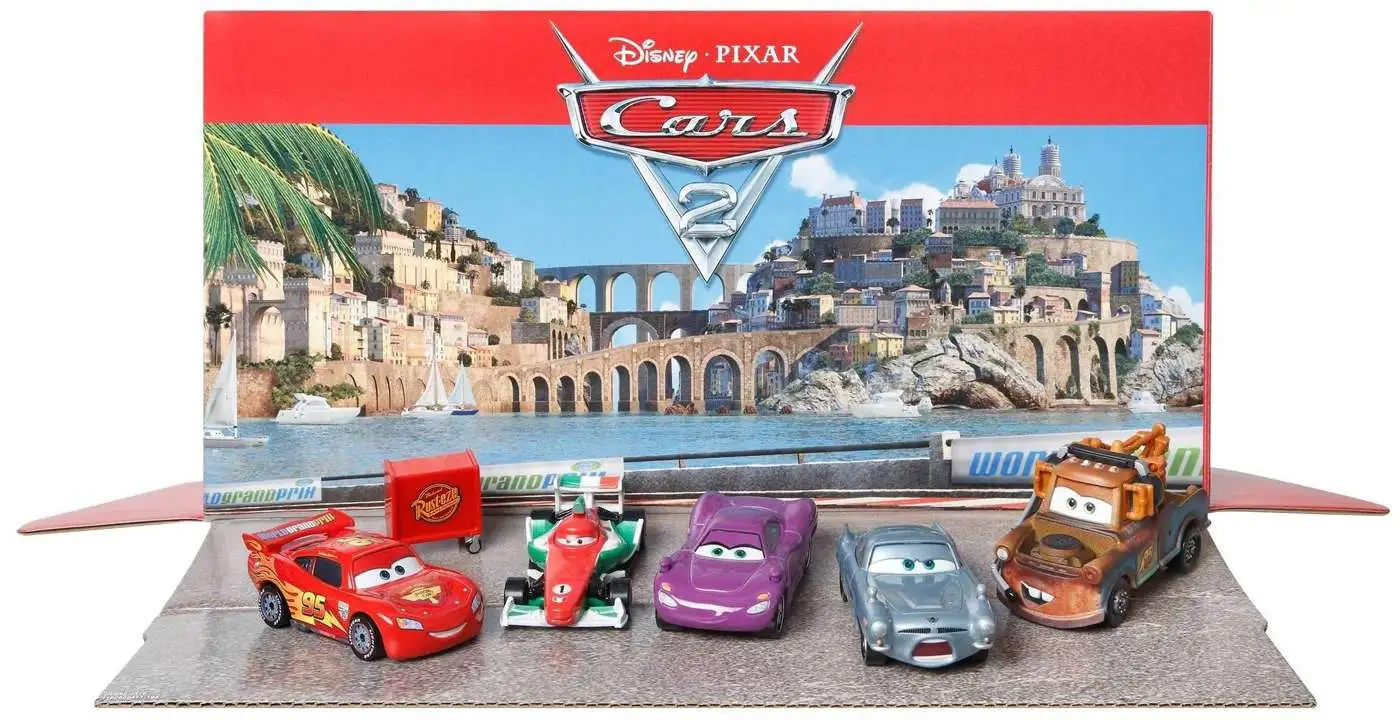
When folks talk about Pixar movies, they usually go for the tear-jerkers like Up or the existential dread of Toy Story. Then there’s Cars 2. It's the black sheep. Critics basically took a sledgehammer to it back in 2011, giving it Pixar’s first "Rotten" score. But honestly? If you look past the spy gadgets and Mater’s accidental espionage, the Cars World Grand Prix Lightning McQueen arc is one of the most technically interesting things the studio ever did.
It wasn't just another Piston Cup race in a dusty dirt bowl. This was a global high-stakes invitation meant to settle a debate: who is actually the fastest car in the world? You've got NASCAR-style stock cars going head-to-head with Formula 1 machines, Le Mans prototypes, and rally legends. It’s a total gearhead’s fever dream that somehow got wrapped in a Disney-branded bow.
The World Grand Prix: What Most People Miss
The World Grand Prix (WGP) wasn't just a backdrop. It was a three-country tour designed by Sir Miles Axlerod, a former oil tycoon turned "green power" advocate. He wanted to showcase Allinol, his synthetic fuel. The races hit Tokyo, Porto Corsa, and London. Each track was a hybrid, mixing smooth tarmac with dirt sections.
That dirt section in Tokyo? That was the equalizer.
In a straight line, Francesco Bernoulli—the Ferrari-inspired F1 car voiced by John Turturro—would smoke a stock car like Lightning McQueen. But F1 cars hate dirt. Their suspension is too stiff; their tires are too thin. McQueen, having learned to drift on the dirt tracks of Radiator Springs under Doc Hudson’s tutelage, had a weird, specific advantage.
The Lineup of Champions
It’s easy to forget how stacked the grid was. We aren't talking about generic background fillers. Pixar’s team spent years researching real-world racing series to build these characters.
- Francesco Bernoulli: Representing Formula 1 (Italy). He's basically the personification of ego with open wheels.
- Jeff Gorvette: A nod to NASCAR legend Jeff Gordon, driving a Corvette C6.R.
- Lewis Hamilton: Actually voiced by the man himself, representing the McLaren heritage.
- Carla Veloso: A Brazilian Le Mans prototype.
- Max Schnell: A German DTM (touring car) powerhouse.
Lighting McQueen was the outlier. He was a four-time Piston Cup champion by this point, but he was strictly an oval racer. Taking a car built for left turns and throwing him into the tight, neon-soaked streets of Tokyo or the cliffside curves of the Italian Riviera was a massive technical leap.
Why Lightning McQueen Had to Change
To compete on a global stage, McQueen couldn't just show up with his 2006 Piston Cup setup. NASCAR stock cars are heavy, brick-like machines. To handle the WGP, Pixar’s designers—led by Jay Ward and Jay Shuster—actually "upgraded" McQueen’s model for the film.
They added working headlights for the first time. They slapped on a new rear diffuser and a refined spoiler to help with the aerodynamics of road racing. His paint job even changed; the classic Rust-eze logo was updated with a "surging flame" design by legendary car customizer Chip Foose.
It’s kinda wild when you think about the physics. A standard NASCAR engine is a $5.8$-liter V8 pushing about $800$ horsepower. Compare that to an F1 car, which is half the weight and built entirely of carbon fiber. On the Porto Corsa track, which looks suspiciously like the Monaco Grand Prix combined with the Amalfi Coast, McQueen should have been destroyed.
But the movie leans into his "all-around" ability. He’s the underdog because he’s versatile, not because he’s the fastest in a vacuum.
The Allinol Conspiracy: More Than Just a Plot Point
The whole "Lemons" plotline with Professor Zündapp and the hidden EMP camera is where the movie loses some people. But from a car culture perspective, it’s a brilliant commentary on the industry. The villains were "lemons"—AMC Gremlins, Pacers, and Yugo-inspired cars. They were the outcasts, the unreliable models that the world laughed at.
Their goal was to sabotage the World Grand Prix using an electromagnetic pulse disguised as a TV camera. This pulse would cause the Allinol fuel to expand and explode.
The Science Check:
In the real world, you can't really make fuel explode with a remote camera pulse quite like that, but the idea of "fuel stability" is a real racing concern. The movie eventually reveals that Allinol was a sham. Axlerod was still an oil baron at heart, trying to make alternative fuels look dangerous so everyone would go back to his massive oil reserves.
Interestingly, Lightning McQueen survived the final race because Fillmore (the hippie VW bus) and Sarge had swapped out his Allinol for Fillmore’s organic biofuel. This is a rare moment where a "deus ex machina" actually makes sense within the character's established world. Fillmore never trusted the big corporate fuel anyway.
The Real-Life Inspiration Behind the Scenes
John Lasseter is a huge car nut. His dad was a parts manager at a Chevy dealership. When they were building the World Grand Prix, the team took massive research trips. They didn't just look at pictures of Tokyo; they studied how the light reflected off the asphalt after a rainstorm.
This is why Cars 2 looks so much better than the first film. They used "Raytracing," which was a massive computational hurdle back in 2011. It allowed the cars to actually reflect each other in their paint. When McQueen and Francesco are side-by-side in the London rain, you can see the neon signs reflecting off their fenders in real-time.
Why the Movie Failed (and Succeeded)
The reason Cars 2 gets a bad rap is that it sidelined the emotional core—the relationship between Lightning and the late Doc Hudson—for a Mater-centric spy comedy. People wanted more of the Cars World Grand Prix Lightning McQueen rivalry and less of the "Mater thinks wasabi is ice cream" jokes.
However, financially? It was a beast. It grossed over $560$ million. The merchandise alone probably paid for a few Pixar buildings. It’s the highest-grossing film in the trilogy globally, mostly because international audiences loved the global racing theme more than the "small-town America" vibe of the first one.
How to Watch the WGP Today Like an Expert
If you're going back to watch these races, stop looking at the main action. Watch the background.
- Tokyo: Look for the cameo of the "Mach 5" from Speed Racer.
- Porto Corsa: Notice how the car-shaped buildings and statues are modeled after classic Italian architecture but with automotive parts (like spark plug columns).
- London: Check out "Big Bentley." The detail in the clock face (which is actually a gear system) is insane.
The World Grand Prix remains the peak of the Cars universe's scale. By Cars 3, the series went back to its roots, focusing on aging and the "Next Gen" racers like Jackson Storm. But for one brief, chaotic moment, Lightning McQueen was a world-class road racer, proving that a kid from a dirt track in Arizona could hang with the finest engineering Europe had to offer.
If you're looking to dive deeper into the lore, I'd suggest checking out the die-cast collecting community. There are versions of the WGP racers that only appeared for seconds on screen, like Rip Clutchgoneski from the fictional country of New Rearendia. The world-building is there; you just have to look under the hood.
Next time you see a red stock car with a lightning bolt, remember he's not just a Piston Cup winner. He's the guy who took on an F1 champion in the rain-slicked streets of London and walked away with his engine intact. That’s gotta count for something.
Actionable Insights for Fans:
- For Gamers: Track down Cars 2: The Video Game. It actually expands on the WGP tracks and lets you play as the international racers.
- For Collectors: The "Precision Series" die-casts are the gold standard for accuracy if you want a WGP-spec McQueen.
- For Movie Buffs: Watch the Porto Corsa race on a 4K screen. The ray-tracing on the water and the car paint is still some of the best work Pixar has ever released.