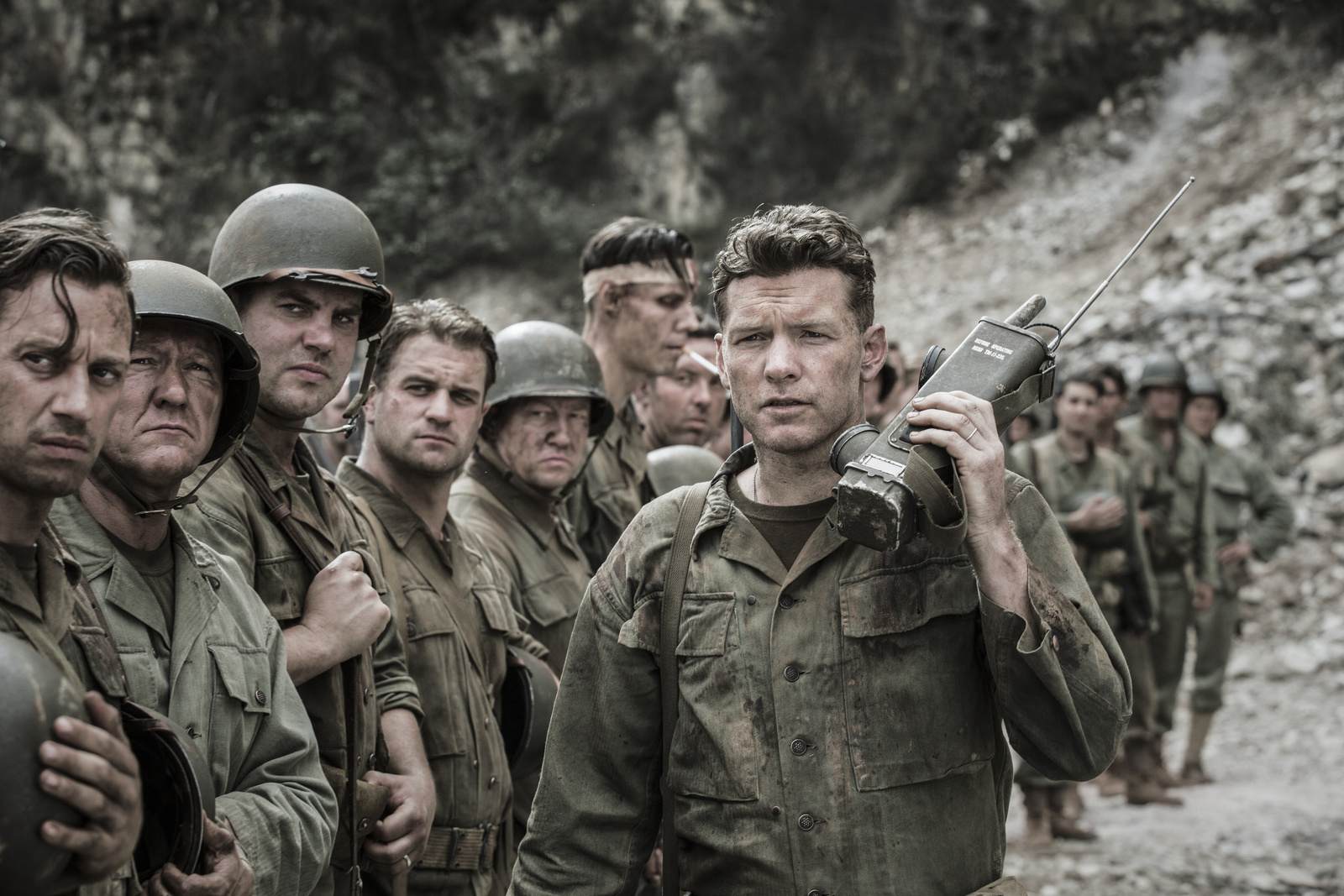
Most people remember Hacksaw Ridge for Andrew Garfield. They remember the bloody, mud-caked cliffs of Okinawa and the near-superhuman pacifism of Desmond Doss. But honestly? The movie doesn't work without Sam Worthington.
He plays Captain Jack Glover.
Glover is the guy who has to deal with the "anomaly." While the rest of the world sees a hero in hindsight, Worthington’s character sees a liability. It's a role that requires a weird mix of authority, frustration, and eventually, a soul-crushing realization that he was dead wrong.
The Tension Between Duty and Belief
Sam Worthington didn't just show up to play a generic "mean officer." If you look at the real history, the actual Captain Jack Glover was a former Detroit policeman. He was tough. He was pragmatic. In the film, Worthington captures that "no-nonsense" energy perfectly.
Imagine being in his shoes.
You’re tasked with training a unit to survive one of the most meat-grinder-style battles in human history. Then, a kid shows up who refuses to touch a rifle. Glover isn't being a "villain" in the traditional sense; he’s trying to protect his men. He believes—rightly so, from a tactical standpoint—that a man without a weapon is a hole in the line.
Worthington plays this with a controlled simmer.
He doesn't shout as much as Vince Vaughn’s Sergeant Howell. Instead, he uses that heavy, authoritative presence to try and "disappear" Doss through legal and psychological means. He tries the psychiatric discharge. He tries the court-martial.
Why the Performance Often Gets Overlooked
For a while, Sam Worthington was the "blockbuster guy." Avatar, Terminator Salvation, Clash of the Titans. People sort of wrote him off as a stoic leading man who didn't have much range.
Sam Worthington in Hacksaw Ridge changed that narrative for a lot of critics.
There is a specific scene late in the movie. The unit is preparing to go back up the ridge. Glover has seen Doss save dozens of men. He has to go to Doss—the man he tried to kick out of the Army—and tell him that the entire company won't go back up without him.
The way Worthington plays that apology is subtle. No big dramatic tears. Just a heavy, weary respect. He realizes that Doss’s conviction was stronger than his own military doctrine. It's a pivot point that anchors the emotional stakes of the final act.
The Accuracy of the Glover/Doss Dynamic
While movies love to "Hollywood-ize" things, the tension between the real Jack Glover and Desmond Doss was very real.
- The Transfer: The real Glover actually went to the battalion commander, Colonel Gerald Cooney, to suggest Doss be transferred. He didn't just want him out of the unit; he wanted him out of the infantry entirely.
- The Turning Point: Just like in the film, the real Glover's opinion did a complete 180-degree flip after seeing Doss in action.
- The Grenade: In the film's climax, Doss deflects a grenade to save his men. In reality, Doss was wounded by a grenade and then hit by a sniper while trying to make sure others got onto the stretchers first.
Worthington reportedly enjoyed the role because it wasn't black and white. It was two men coming at the idea of "saving lives" from two completely different directions.
A Career Re-Pivot
After Hacksaw Ridge, Worthington’s trajectory felt different. He started leaning into these "weathered" roles. Characters who have seen some stuff.
Mel Gibson, who directed the film, is known for pushing his actors into high-intensity, visceral spaces. Worthington had to hold his own against Andrew Garfield’s high-energy performance and Vince Vaughn’s surprising dramatic turn. He became the "center of gravity" for the military side of the story.
If you watch it again, pay attention to his eyes during the briefing scenes. You can see the shift from "this kid is a nuisance" to "this kid might be the only one of us who actually knows what he's doing."
What We Can Learn from Captain Glover
Honestly, the lesson in the Sam Worthington Hacksaw Ridge performance is about the danger of certainty. Glover was "certain" Doss would fail. He was "certain" the rules of war were absolute.
He was wrong.
And the mark of a leader—the kind of leader Worthington portrays—is the ability to admit that error and change course. It’s a study in humility under fire.
If you’re a fan of war cinema or just want to see a different side of the Avatar star, go back and watch the scenes where Glover isn't speaking. The way he watches Doss from the sidelines. It's some of the most nuanced work he’s ever put on screen.
Next Steps for the Viewer:
- Watch the "Apology Scene": Compare Worthington's quiet delivery to the loud chaos of the battlefield that follows.
- Check the History: Look up the real 77th Infantry Division. The movie omits battles in Guam and Leyte where Doss also performed heroically, which makes Glover's realization even more earned in real life.
- Compare with Avatar: Notice the difference in how Worthington uses his voice when he isn't playing a "hero" archetype and is instead playing a conflicted middle-manager of war.